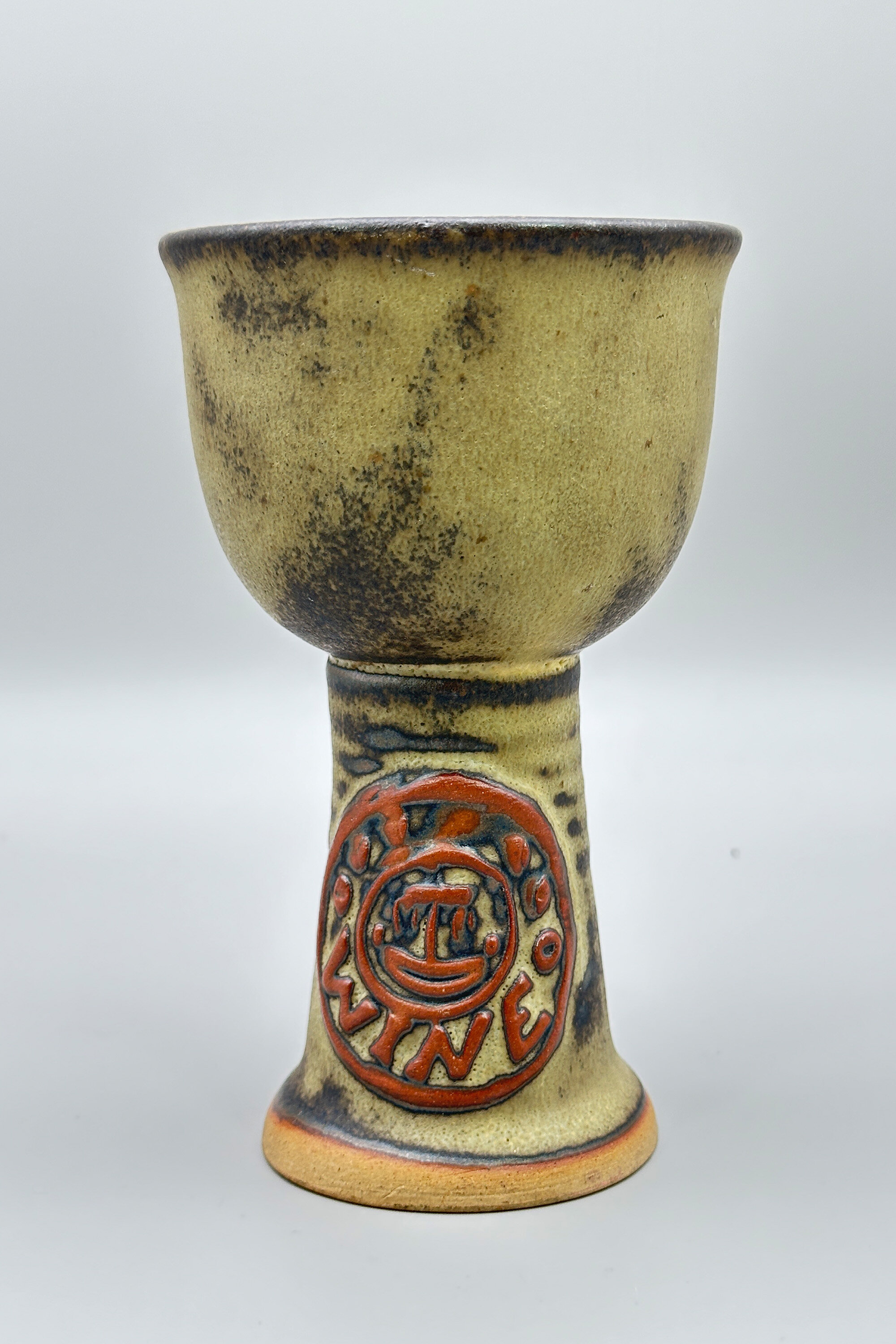
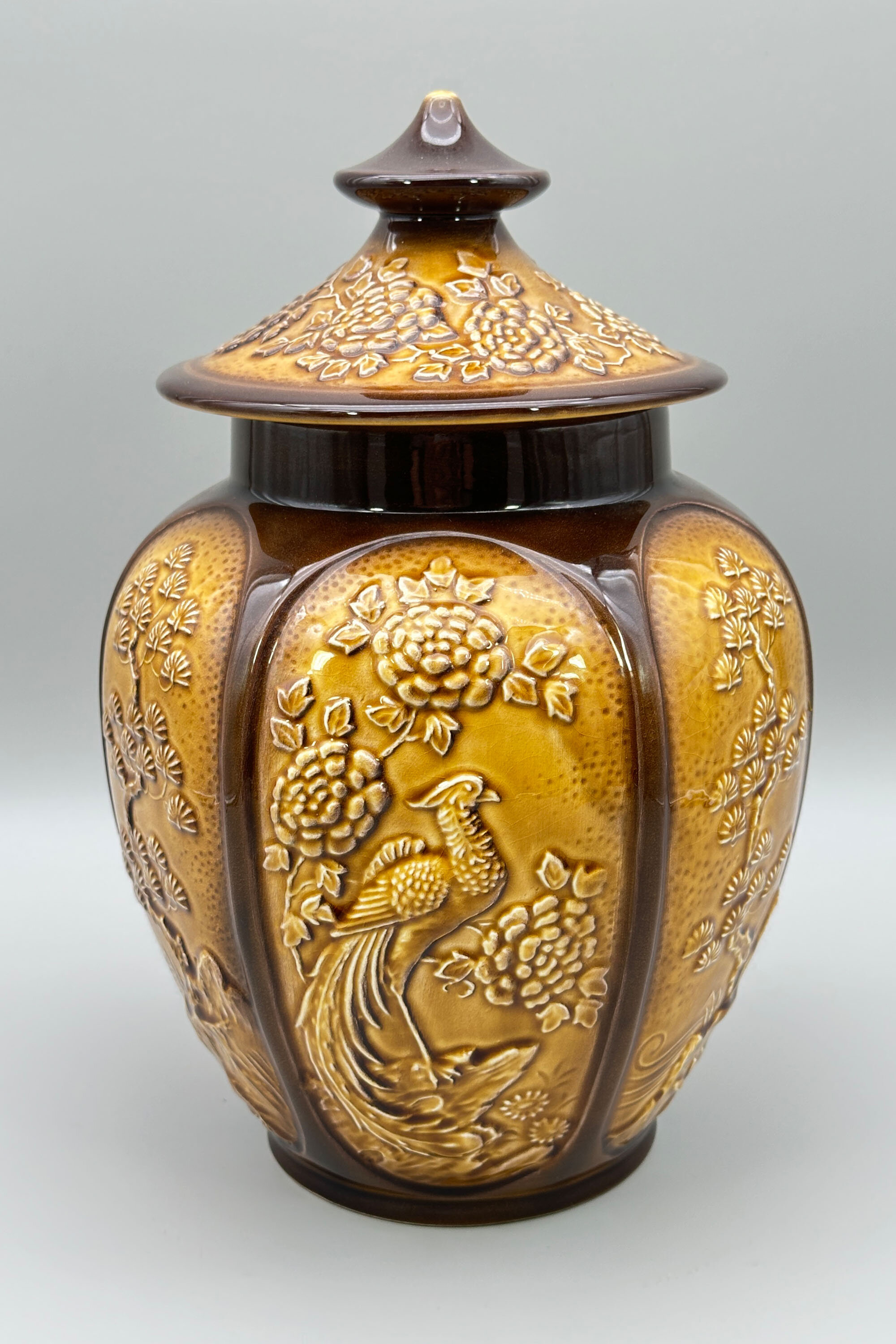
Exceptionally large Sylvac Jar and Cover, Canton pattern, 1970s
Price: £95The format of the label (the complete version can be seen in image 9) dates this piece to the 1970s The design here with its Oriental influence and often termed ‘Canton’ was one of the most successful produced by Sylvac in the post war years. It was made in a variety of colourings and a variety of sizes, this example being exceptionally and unusually large making it a striking decorative accessory for a modern interior.
‘SylvaC’ (the name was written with a capital ‘C’ after registration of the trademark in 1938) was a trade name of Shaw and Copestake, a company formed by Mr. William Shaw and a Mr. Copestake around 1900. Mr. Copestake sold his shares to a Mr. Richard Hull after about six months of business and this partnership continued until Mr. Hull’s death in 1935. He was succeeded by his son, Mr. Richard Hull junior. In the following year, the business became a limited company. Various mergers and acquisitions followed and in the 1950s new premises were built and production expanded considerably continuing until the early 1980s when changing markets and increased competition forced the company into liquidation.
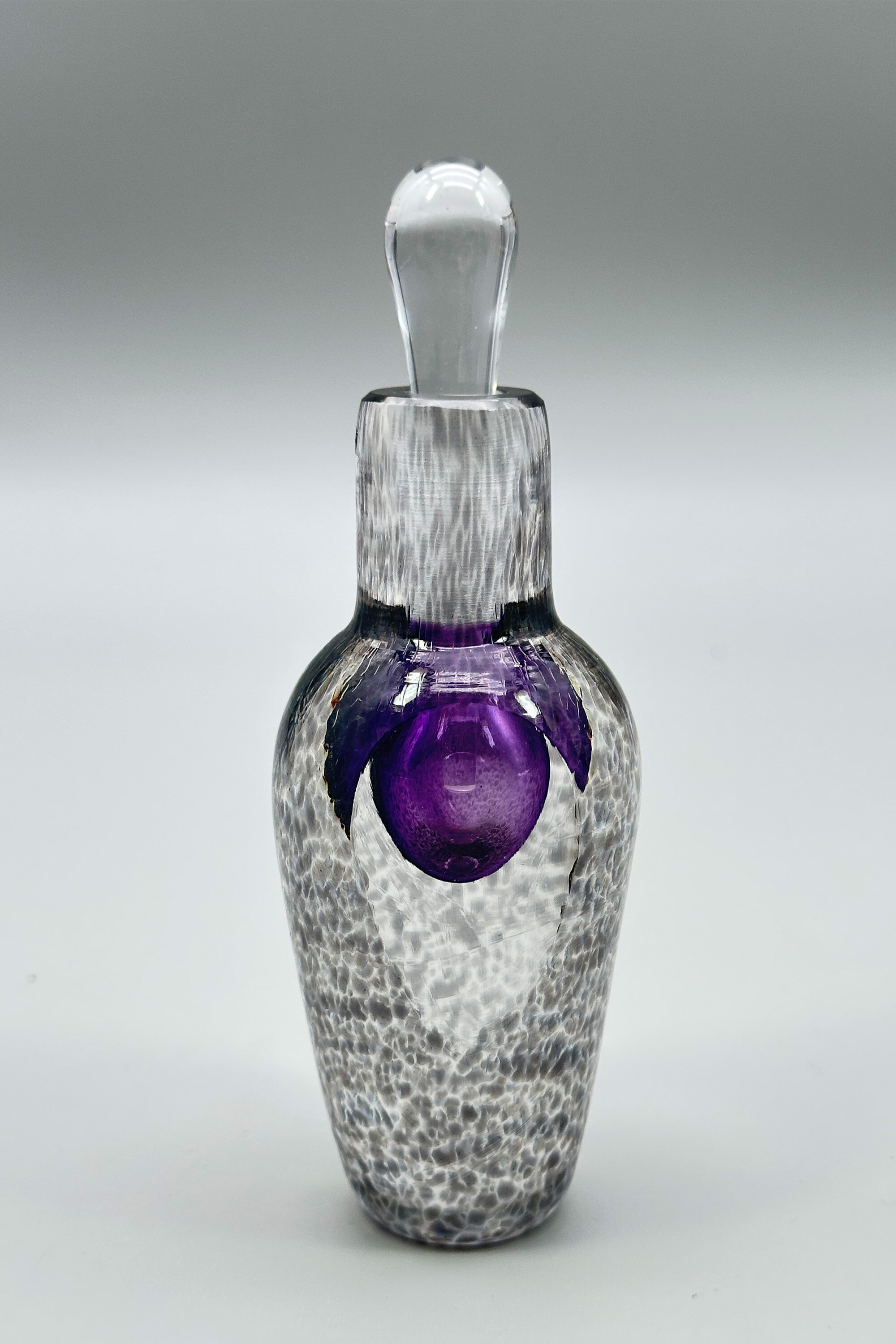
Perfume Bottle and Stopper, Stuart Akroyd, signed J S A, late C20th
Price: £75The signature here, which occurs on other pieces by the same artist, is for Stuart Akroyd, a celebrated English glassmaker who worked from studios in Sunderland then Sheffield from 1991 to 2021(see image 8). Born in 1966, Akroyd studied at Sunderland University, following this with a Post Graduate Diploma at the International Glass Centre, Brierley Hill. After working as the head maker at Lakeland Crystal, Cumbria he went on to establish his own business, Stuart Akroyd Glass Designs, in 1991, renaming it Stuart Akroyd Contemporary Glass when he moved from Sunderland to Sheffield in 2000. Best known for his sculptural pieces which were inspired by the ‘Skylon’ structure, the well known symbol of the 1951 Festival of Britain, Akroyd also worked on a smaller scale and there a number of small bottles by him of which this is an excellent example. The glass effects are skilful and inventive and the flat panel to the body is both decorative and functional, allowing the level of fluid in the bottle to be seen clearly. Many of his sculptural pieces were made in his later Sheffield workshop which, with its greater space, allowed him to employ the techniques necessary to create them, so it is a reasonable guess that this bottle and its companions belong to the first phase of his output.
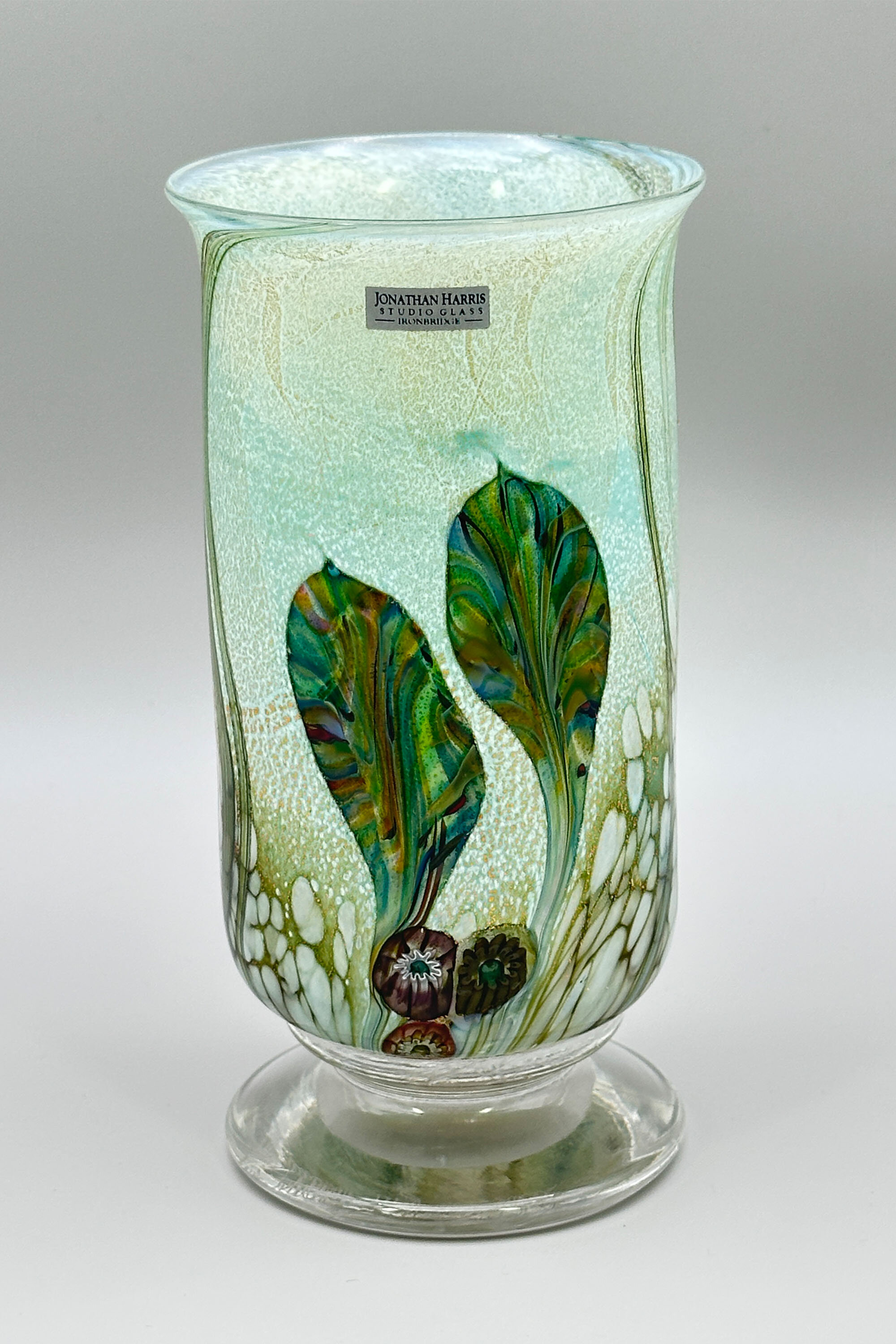
Cameo art glass Vase decorated lilies, Jonathan Harris Glass, signed and dated 2006
Price: £35Born in 1965 Jonathan Harris (see image 13) is one of the sons of the famous glassmaker Michael Harris who founded Mdina glass in 1968 and then Isle of Wight Glass in 1972. Jonathan worked with his Father in the Isle of Wight studio and is said, with his Father’s help, to have blown a glass fish, aged eight. After studying glass at Stourbridge college and a long spell at Isle of Wight Glass, where he became managing director 1992, Jonathan and his wife Alison set up their own studio in the Ironbridge Gorge, Shropshire in 2000 being given permission to establish their own premises within the Coalport China Museum complex.
The aim of the studio was to assemble a highly talented team of glassmakers to develop complex and intricate glass making techniques drawing inspiration from such designers as Galle and Tiffany but also, like his Father, from the natural world. A wide variety of influences can be seen including Gothic, Art Nouveau and Art Deco. It is perhaps the second of these which is most closely seen here and the technique is one resembling cameo glass where the surface of the glass is skilfully carved by hand through layers of enamel colours, 24ct gold & sterling silver leaf to reveal an intricate design in outstanding detail. All the art glass pieces are unique and all hand signed by Jonathan Harris himself making this vase an impressive example of his studio’s output.